Back to News
Voice AI for Sales: How AI Phone Calls Are Booking Real Meetings in 2026
Rocket Agents Team
April 11, 2026
#voice-ai#ai-calling#sales-automation#phone-sales#ai-sdr

It wasn't long ago that "AI phone calls" meant a robotic voice stumbling through a script, mispronouncing names, and getting hung up on within seconds. Those days are over. In 2026, AI voice agents are booking real meetings with real prospects — and most of the time, the person on the other end of the line has no idea they're talking to a machine.
This isn't science fiction. It's happening right now, across thousands of sales teams, and the results are forcing a fundamental rethinking of how outbound sales works.
From Robocalls to Intelligent Conversations
The history of automated phone outreach is, frankly, embarrassing. Robocalls became so universally despised that entire regulatory frameworks were built to stop them. The TCPA, do-not-call registries, STIR/SHAKEN caller ID authentication — all of it exists because early automation was crude, annoying, and exploitative.
But modern voice AI is a completely different technology. Where robocalls played pre-recorded messages, today's AI voice agents generate responses in real time. They listen, they understand context, they adapt. They handle interruptions, unexpected questions, and even objections — all without missing a beat.
The difference is like comparing a telegram to a FaceTime call. Same category, entirely different experience.
How Modern Voice AI Actually Works
Under the hood, today's voice AI systems combine several breakthrough technologies:
Speech Recognition (ASR): Advanced automatic speech recognition converts the prospect's spoken words into text with near-human accuracy. Modern models handle accents, background noise, crosstalk, and domain-specific vocabulary that would have tripped up systems even two years ago.
Natural Language Understanding (NLU): Once the speech is transcribed, NLU models parse the meaning — not just the words. They understand intent, sentiment, and context. When a prospect says "I'm kind of busy right now," the AI understands that's a soft objection, not a hard no.
Real-Time Response Generation: Large language models generate contextually appropriate responses in milliseconds. The AI doesn't pick from a script tree — it constructs novel responses based on the conversation flow, the prospect's profile, and the campaign's goals.
Text-to-Speech (TTS): Neural voice synthesis converts the generated response back into natural-sounding speech. Modern TTS engines produce voices with natural prosody, appropriate pauses, and even vocal fillers like "mm-hmm" that make the conversation feel human.
Latency Optimization: The entire pipeline — hear, understand, think, speak — happens in under 500 milliseconds. That's faster than most humans respond in conversation. There's no awkward pause that screams "you're talking to a robot."
The Uncanny Valley Is Behind Us
Two years ago, prospects could usually tell within 10 seconds that they were talking to an AI. The voice was too perfect, the responses too prompt, the conversation too linear. Today, the detection rate has plummeted.
Several factors have converged to make AI voices nearly indistinguishable from human callers:
Voice cloning and customization allow companies to create unique voice profiles that sound natural and warm — not like a generic text-to-speech engine. These voices have personality, natural speech patterns, and even regional characteristics.
Conversational dynamics have been refined to include the small imperfections that make human speech feel real. Strategic pauses, thoughtful "hmm" moments, and natural transitions between topics all contribute to a conversation that flows like a real call.
Context awareness means the AI remembers what was said earlier in the conversation, references specific details about the prospect's company, and builds on previous points — just like a skilled sales rep would.
The result: prospects engage in full conversations, share their pain points, and book meetings — all without realizing they're talking to an AI. When they show up to the meeting with a human rep, the handoff is seamless.
Smart Timing: When the AI Calls Matters as Much as What It Says
One of the most underappreciated advantages of AI voice agents is their ability to optimize call timing with surgical precision.
Human SDRs make calls when they're at their desk, which usually means 9-to-5 in their own timezone. AI doesn't have a timezone. It doesn't take lunch breaks. It doesn't lose energy at 3 PM on a Friday.
Modern AI calling platforms analyze data to determine the optimal calling windows for each prospect based on:
- Industry patterns: Construction company owners answer at 6 AM. SaaS executives pick up after 4 PM when their meeting blocks end.
- Historical data: If a prospect picked up on Tuesday at 2 PM last time, the AI will try that window again.
- Time zone intelligence: Automatically adjusting for the prospect's local time, not the caller's.
- Day-of-week optimization: Some industries are more responsive on specific days. The AI learns these patterns across thousands of calls.
Smart retry logic is equally important. When a call goes unanswered, the AI doesn't just hammer the phone. It spaces retries intelligently — varying the time of day, the day of the week, and even the approach. After three missed calls, it might switch to SMS or email before trying voice again. This multi-channel awareness dramatically increases eventual connection rates.
Handling Live Objections: Where AI Really Shines
The biggest concern sales leaders have about AI calling is objection handling. "What happens when the prospect pushes back?" It's a fair question — and the answer is surprisingly impressive.
Traditional IVR (Interactive Voice Response) systems crumble when a prospect goes off-script. "Press 1 for yes, press 2 for no" doesn't work in a sales conversation. Real prospects say things like:
- "We just signed a contract with someone else last month."
- "How did you get my number?"
- "I'm interested but my boss would need to approve this."
- "Can you call back in two weeks? We're in the middle of a migration."
AI voice agents handle all of these naturally. They're trained on thousands of real sales conversations and understand the taxonomy of objections:
Timing objections ("Not right now" / "Call back later"): The AI acknowledges the timing, offers to schedule a specific callback, and follows up at exactly the right moment.
Authority objections ("I need to check with my boss"): The AI asks smart qualifying questions — who else is involved in the decision, what their evaluation criteria are, whether it would be helpful to send materials they can share internally.
Competitor objections ("We already use X"): The AI doesn't trash the competitor. It asks about their experience, identifies potential gaps, and positions the conversation around outcomes rather than features.
Source objections ("How did you get my number?"): The AI provides a clear, honest answer about the outreach context and immediately offers to remove them from the list if they're not interested — building trust rather than destroying it.
Budget objections ("We can't afford it right now"): The AI explores the ROI angle, asks about the cost of their current approach, and reframes the conversation around value rather than price.
The key difference from scripted systems: the AI generates novel responses tailored to the specific objection and context. It doesn't retrieve a canned response — it reasons through the objection in real time.
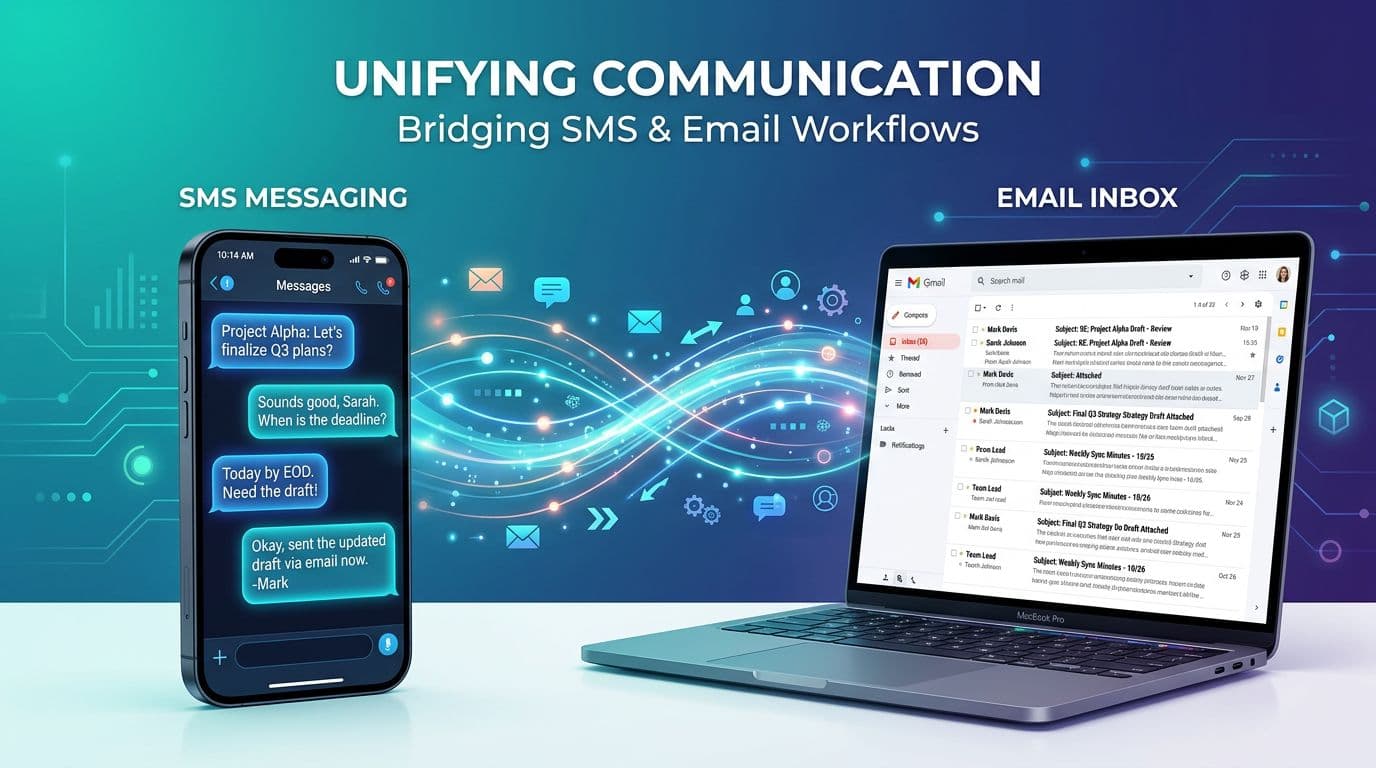
The Orchestration Advantage: Voice + SMS + Email
Voice AI becomes exponentially more powerful when it's part of a coordinated multi-channel strategy. The best results come from intelligent orchestration across voice, SMS, and email.
Here's what a modern AI-orchestrated outreach sequence looks like:
Day 1: AI sends a personalized email introducing the value proposition, referencing something specific about the prospect's company.
Day 2: AI sends a brief SMS — casual, direct, and conversational. "Hi [Name], sent you a note yesterday about [topic]. Worth a quick chat?"
Day 3: AI makes the first call. If the prospect picks up, it references the email and SMS. If they don't, it leaves a voicemail that ties back to the previous touches.
Day 5: Follow-up email with additional context based on any engagement signals (email opened, link clicked, SMS read).
Day 7: Second call attempt, different time of day. If connected, the AI has full context of every previous interaction.
This isn't a rigid sequence — the AI adapts based on prospect behavior. If someone replies to the SMS saying "Call me Thursday," the AI adjusts the entire sequence. If someone opens the email four times, the AI might accelerate the call.
The result is a prospect experience that feels coordinated and intentional, not like they're being blasted by three different systems.
Compliance: Doing It Right
Any conversation about AI calling must address compliance. The regulatory landscape is real, and the penalties for violations are severe.
TCPA (Telephone Consumer Protection Act): The TCPA requires prior express consent for automated calls. Modern AI calling platforms are built with consent management at their core — tracking opt-in sources, maintaining consent records, and automatically suppressing non-consented contacts.
Do-Not-Call (DNC) Lists: AI systems automatically scrub against the National DNC Registry, state-specific DNC lists, and internal suppression lists. This happens before every call, not just at import time, because prospects can add themselves to DNC lists at any time.
STIR/SHAKEN: Caller ID authentication ensures calls display legitimate business numbers, not spoofed IDs. This improves answer rates and keeps your numbers from being flagged as spam.
State-Specific Regulations: Some states have additional requirements — two-party consent for recording, specific calling hour restrictions, or additional disclosure requirements. Modern platforms handle this automatically based on the prospect's location.
Disclosure: While regulations vary by jurisdiction, best practice is to be prepared to identify the AI nature of the call if directly asked. Transparency builds trust and avoids potential legal issues.
The key insight: compliance isn't a burden — it's a competitive advantage. Prospects who consent to being contacted are more likely to engage. Clean calling practices maintain number reputation, which keeps answer rates high. And companies that play by the rules don't get hit with six-figure fines.
The Numbers: What AI Voice Agents Actually Deliver
Let's talk results. Across thousands of campaigns, here's what the data shows:
Connection rates: AI voice agents achieve 15-25% connection rates on cold outbound calls. This is comparable to skilled human SDRs — and dramatically better than the 3-5% response rates typical of cold email alone.
Conversation-to-meeting rate: When the AI connects with a prospect, 20-35% of those conversations result in a booked meeting. The AI's consistency — it never has a bad day, never rushes through a call, never gets flustered — drives these numbers.
Cost per meeting: This is where the math gets compelling. A human SDR costs $60,000-80,000 per year fully loaded, books 10-15 meetings per week, and works 40 hours. AI voice agents can run 24/7, handle hundreds of simultaneous calls, and reduce cost per meeting by 60-80%.
Speed to lead: AI voice agents can call a new inbound lead within 60 seconds of form submission. The data is clear — contacting a lead within 5 minutes is 21x more effective than waiting 30 minutes. AI makes sub-minute response times the default, not the exception.
Consistency: Human SDRs have good days and bad days. They get tired, distracted, and burned out. AI delivers the same quality conversation at 8 AM and 8 PM, on Monday and Friday, on the first call of the day and the five hundredth.
The Human-AI Handoff
AI voice agents aren't replacing human salespeople — they're amplifying them. The optimal model is clear: AI handles the high-volume, repetitive work of connecting with prospects and qualifying interest. Humans handle the high-value work of building relationships, running demos, and closing deals.
When an AI voice agent books a meeting, the human rep walks in with full context: what the prospect said, what objections they raised, what they're most interested in, and what their timeline looks like. It's like having the world's most thorough SDR doing your prospecting.
The reps who've embraced this model report spending 80% more time in actual sales conversations — the part of the job they love — and 80% less time cold calling, leaving voicemails, and getting rejected.
What's Next
Voice AI is evolving fast. In the next 12-18 months, expect to see:
- Emotional intelligence improvements: AI that detects frustration, excitement, or hesitation in real time and adjusts its approach accordingly.
- Multi-language support: Seamless conversations in any language, with automatic detection and switching.
- Deeper CRM integration: AI that not only books the meeting but updates every field in your CRM, creates follow-up tasks, and prepares briefing docs for the rep.
- Video AI agents: The same technology applied to video calls, with AI avatars that can run initial discovery meetings.
The Bottom Line
Voice AI for sales isn't coming — it's here. The companies that are adopting it now are booking more meetings, at lower cost, with higher consistency than their competitors. The technology has crossed the threshold from "interesting experiment" to "competitive necessity."
The question isn't whether AI voice agents work. The data proves they do. The question is how long you can afford to have your human team manually dialing when your competitors have AI doing it around the clock.
If you're ready to see what AI voice agents can do for your pipeline, start your free trial with Rocket Agents and launch your first AI calling campaign in minutes.
Written by
Rocket Agents Team
Part of the Rocket Agents team, helping businesses convert more leads into meetings with AI-powered sales automation.

Ready to Convert More Leads?
See how Rocket Agents can help you respond to leads instantly and book more meetings.