
Back to News
Automated Meeting Booking: How AI Eliminates the Back-and-Forth Scheduling Nightmare
Rocket Agents Team
March 24, 2026
#meeting-booking#scheduling-automation#calendar-integration#ai-scheduling#sales-meetings
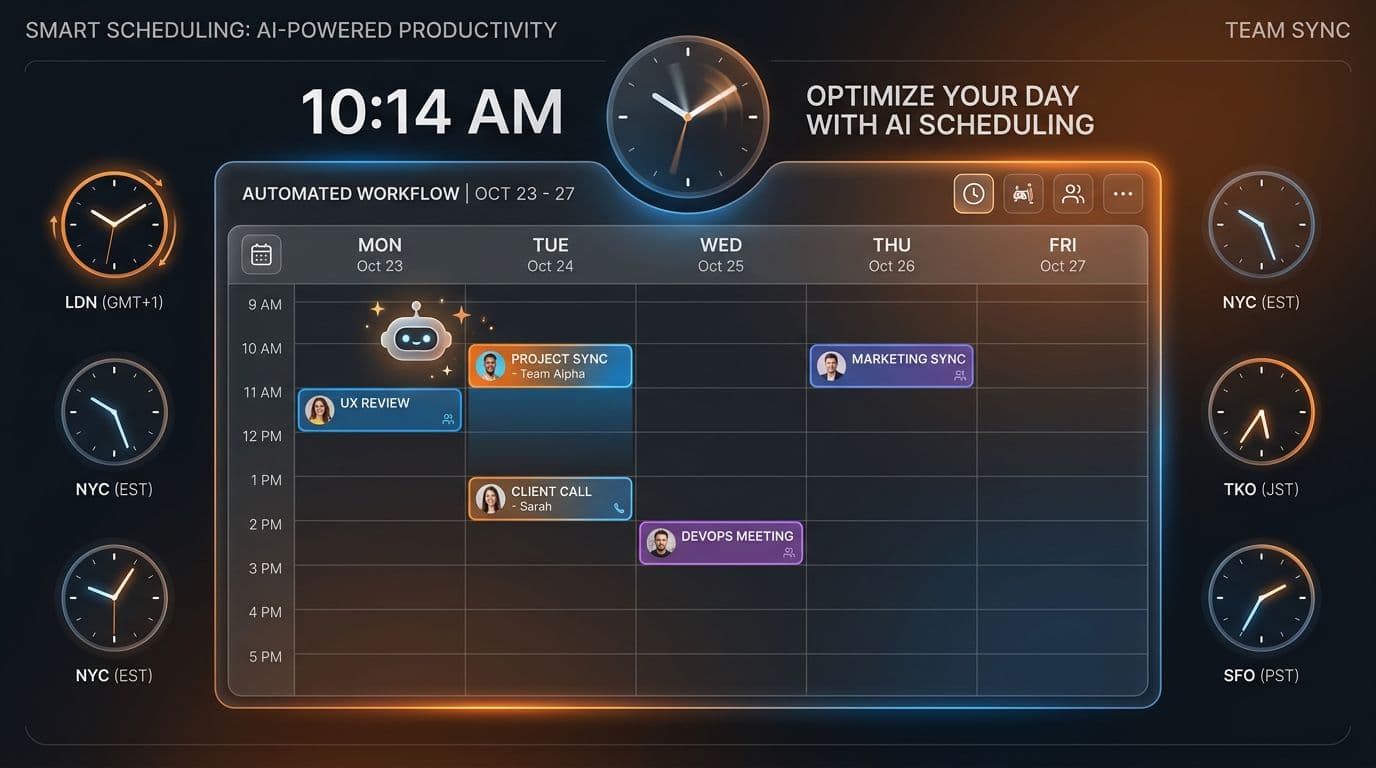
Meeting booking should be simple. A prospect says "let's talk," and you find a time that works. In reality, it's one of the most frustrating bottlenecks in the entire sales process -- and it's costing your team deals every single day.
Research from HubSpot shows that the average B2B meeting takes 8.1 email exchanges to schedule. Eight messages back and forth just to land on a 30-minute call. In a world where speed-to-lead determines who wins the deal, that kind of friction is unacceptable.
AI-powered meeting booking eliminates this problem entirely. Instead of endless scheduling threads, prospects get instant, intelligent booking experiences that respect their time, their timezone, and their preferences -- all without a single human rep lifting a finger.
Here's how it works, and why it matters more than you think.
The Real Cost of Manual Scheduling
Let's do the math. If your sales team books 50 meetings per week and each one requires 8 email exchanges, that's 400 scheduling-related emails per week. At an average of 3 minutes per email (reading, checking calendars, composing a reply), your team spends 20 hours per week just coordinating calendars.
That's half a full-time employee's workload dedicated entirely to administrative scheduling. Not selling. Not building relationships. Not closing deals. Just figuring out when to have a conversation.
But the time cost isn't even the worst part. The real damage is what happens during those 8 exchanges: prospects go cold.
Every hour that passes between a prospect expressing interest and actually sitting down for a meeting increases the likelihood they'll ghost, research a competitor, or simply lose the urgency that prompted them to engage in the first place.
A study by InsideSales.com found that responding to a lead within 5 minutes makes you 21 times more likely to qualify that lead compared to responding after 30 minutes. The same principle applies to scheduling. The faster you lock in a meeting, the more likely it is to happen.
How AI-Powered Meeting Booking Works
AI scheduling isn't just a glorified calendar link. It's an intelligent system that handles the entire booking lifecycle -- from initial time proposal to post-meeting follow-up. Here's what that looks like in practice.
Real-Time Calendar Integration
The foundation of AI scheduling is deep integration with your team's calendars. When an AI agent proposes meeting times, it's not guessing. It's checking real-time availability across every rep's Google Calendar or Microsoft Outlook account, factoring in:
- Existing meetings and blocks -- no double-booking, ever
- Buffer times -- configurable gaps between meetings so reps aren't running back-to-back calls all day
- Working hours -- respecting each rep's defined availability window
- Meeting type durations -- automatically allocating 15, 30, or 60 minutes based on the meeting purpose
This isn't a static snapshot. The AI checks availability at the moment of booking, which means even if a rep's calendar changed 30 seconds ago, the proposed times are accurate.
Instant Proposals in Natural Conversation
Here's where AI scheduling diverges from traditional booking tools. Instead of sending a prospect a generic Calendly link and hoping they click it, the AI agent proposes specific times within the natural flow of conversation.
If a prospect replies to an email saying "Sure, I'd love to chat next week," the AI doesn't respond with "Here's my booking link." Instead, it says something like:
"Great to hear! I have a few times available next week that might work:
- Tuesday, March 25 at 10:00 AM PT
- Wednesday, March 26 at 2:00 PM PT
- Thursday, March 27 at 11:00 AM PT
Which of these works best for you? If none of these fit, just let me know your preferred times and I'll find something that works."
This feels human. It feels like talking to a real sales rep who checked their calendar and offered options. The prospect simply replies with their preference, and the meeting is booked instantly -- calendar invite sent, confirmation delivered, done.
No links to click. No forms to fill out. No friction whatsoever.
The Timezone Challenge (And How AI Solves It)
If you've ever tried to schedule a meeting with someone in a different timezone, you know the pain. "Does 3 PM work?" "3 PM your time or mine?" "Wait, are you on Eastern or Pacific?" "Is daylight savings in effect yet?"
For global sales teams, timezone confusion is a meeting-killer. It leads to no-shows, double-bookings, and frustrated prospects who feel like you can't even get a simple calendar invite right.
AI handles timezone negotiation effortlessly. Here's how:
Automatic Timezone Detection
When an AI agent communicates with a prospect, it determines their timezone through multiple signals -- their location data, their email headers, their stated preferences, or simply by asking naturally within conversation. Once identified, every time proposal is automatically converted to the prospect's local timezone.
A rep in New York doesn't need to calculate that their 2 PM ET is 11 AM PT for a prospect in San Francisco. The AI handles the conversion both ways, presenting times in whatever format is most natural for each party.
Daylight Saving Time Awareness
One of the most common scheduling errors happens during DST transitions. A meeting booked two weeks in advance might end up an hour off if the system doesn't account for upcoming time changes. AI scheduling systems factor in DST transitions for every timezone involved, so a meeting booked today for three weeks from now will still land at the correct time.
Multi-Timezone Team Support
For organizations with reps across multiple timezones, AI scheduling ensures that proposed times fall within acceptable working hours for both the rep and the prospect. If your prospect is in London and your rep is in Chicago, the AI will only propose times that work during business hours on both ends -- no 6 AM calls for anyone.
Reducing No-Shows: The Automated Reminder Engine
Booking a meeting is only half the battle. Getting both parties to actually show up is the other half. Industry data suggests that 20-30% of scheduled sales meetings end up as no-shows. That's nearly one in every three or four meetings -- wasted slots that could have been filled with engaged prospects.
AI-powered scheduling combats no-shows with a multi-touch reminder and confirmation system.
Pre-Meeting Confirmation Sequence
Rather than sending a single calendar invite and hoping for the best, AI agents execute a strategic confirmation sequence:
-
Immediate confirmation -- As soon as the meeting is booked, the prospect receives a confirmation with all details: date, time (in their timezone), meeting link, and what to expect.
-
24-hour reminder -- The day before the meeting, the AI sends a friendly reminder. But it's not just "Don't forget about our meeting." It re-emphasizes the value: "Looking forward to showing you how we can help with [their specific pain point] tomorrow at 2 PM."
-
1-hour reminder -- A final nudge one hour before, including the meeting link for easy access. This catches people who might have forgotten or lost the original invite.
-
Reschedule option -- Every reminder includes an easy way to reschedule rather than simply not showing up. People are far more likely to reschedule than to proactively cancel, but only if you make it effortless.
Smart Reschedule Handling
When a prospect needs to reschedule, the AI doesn't treat it as a failure. It immediately proposes alternative times, maintains the conversational context, and rebooks without requiring the prospect to start over. The tone stays positive and accommodating:
"No problem at all! Let's find a better time. I have availability on Thursday at 1 PM or Friday at 10 AM -- would either of those work?"
This frictionless rescheduling recovers meetings that would otherwise become permanent no-shows. Data from our platform shows that automated reschedule handling recovers up to 40% of meetings that would have been lost entirely.
The Psychology of Meeting Booking: Why Speed Wins
There's a well-documented psychological principle at work in meeting booking: the intention-action gap. When someone expresses interest in meeting ("Sure, let's schedule a call"), they're at peak intent. Every minute that passes between that expression and the actual booking creates space for the gap to widen.
Here's what happens in that gap:
- Cognitive load increases -- The prospect has to remember to respond, check their calendar, compose a reply. Each step is a potential dropout point.
- Competing priorities emerge -- Other emails arrive, other meetings happen, other vendors reach out. Your meeting request gets buried.
- Urgency fades -- The pain point that motivated them to engage feels less acute. "I'll get to that later" becomes "I'll get to that next quarter" becomes forgotten.
AI scheduling collapses this gap to nearly zero. When a prospect says "let's meet," the AI responds within seconds with specific times. The prospect picks one and it's done. Total elapsed time from interest to booked meeting: under 2 minutes.
Compare that to the traditional flow: prospect says "let's meet," rep sees the email 3 hours later, checks their calendar, replies with times, prospect sees the reply the next morning, checks their calendar, replies back, rep confirms -- total elapsed time: 24-48 hours minimum, often a full week.
In that week, the prospect had 15 other vendor conversations. Yours just lost priority.
Beyond Calendly: Why AI Beats Static Booking Links
You might be thinking, "We already use Calendly (or SavvyCal, or Cal.com). Problem solved." Not quite.
Static booking links solve one problem -- they let prospects self-schedule. But they create others:
The Link Problem
Sending a booking link feels transactional. It says "I'm too busy to find a time for you, so here's a link." For high-value enterprise prospects, this can feel dismissive. AI scheduling proposes times within a personal conversation, maintaining the relationship-first approach that enterprise sales requires.
The Context Problem
A booking link has no context. The prospect clicks it, picks a time, and shows up. But the AI doesn't know why they're booking or what they care about. AI scheduling captures context from the conversation -- the prospect's pain points, their timeline, their specific interests -- and passes that to the rep before the meeting. The rep walks in prepared, not cold.
The Round-Robin Problem
Static booking links typically assign meetings to whoever's link the prospect clicked, or distribute via basic round-robin. AI scheduling can make smarter assignments based on:
- Territory -- Route based on the prospect's geography
- Expertise -- Match prospects to reps who specialize in their industry or use case
- Relationship -- If a prospect has spoken with a specific rep before, route back to them
- Performance -- Weight assignments toward reps with higher conversion rates
The Follow-Up Problem
A booking link doesn't follow up. If a prospect clicks the link but doesn't complete the booking, they're gone. AI scheduling detects abandoned booking attempts and follows up intelligently: "I noticed you were looking at times for us to connect. Would any of these work better?"
AI-Optimized Meeting Time Selection
Not all meeting times are created equal. Data analysis across thousands of booked meetings reveals clear patterns in which time slots convert best:
- Tuesday through Thursday consistently outperform Monday and Friday for meeting show rates
- Mid-morning (10-11 AM local time) tends to have the highest engagement
- Post-lunch slots (1-2 PM) show elevated no-show rates
- End-of-day meetings (4-5 PM) have higher cancellation rates
AI scheduling systems learn from your organization's specific data. If your Tuesday 10 AM meetings convert at 85% but your Friday 4 PM meetings convert at 40%, the AI will prioritize proposing Tuesday mornings. This isn't a static rule -- it's a continuously learning model that adapts to your market, your prospects, and your team's patterns.
Over time, this data-driven time selection can meaningfully improve your meeting-to-opportunity conversion rate simply by booking meetings at times when prospects are most likely to show up and engage.
Handling Cancellations Gracefully
Cancellations happen. A prospect's priorities shift, budgets get frozen, internal champions leave companies. The difference between a lost deal and a recovered opportunity often comes down to how you handle the cancellation.
AI scheduling handles cancellations with a structured recovery flow:
- Acknowledge gracefully -- No guilt trips, no passive aggression. "Completely understand -- things come up."
- Offer immediate rescheduling -- "Would you like to find another time that works better?"
- Preserve context -- If they reschedule for two weeks later, the AI remembers everything from the original conversation. The prospect doesn't have to re-explain their situation.
- Nurture if delayed -- If the prospect says "not right now, maybe next quarter," the AI adds them to a nurture sequence and reaches back out at the appropriate time with a personalized message.
This systematic approach to cancellation handling ensures that a cancelled meeting isn't a dead end -- it's a pause in an ongoing relationship.
Calendar Integration That Actually Works
Seamless calendar integration is non-negotiable for AI scheduling. Here's what a robust integration looks like:
Google Calendar / Google Workspace
Full read/write access to check availability and create events. Support for multiple calendars per rep (personal + work), resource calendars (conference rooms), and shared team calendars. Events created by the AI include all relevant details: attendee info, meeting links, agenda notes from the conversation, and prep materials for the rep.
Microsoft Outlook / Office 365
Same full integration for Microsoft environments, including support for Exchange on-premises setups. Calendar events sync bidirectionally, so changes made in Outlook are immediately reflected in the AI's availability calculations.
Meeting Link Generation
Automatic creation of video meeting links (Google Meet, Zoom, Microsoft Teams) based on your organization's preferred platform. No manual step required -- the link is generated and included in the calendar invite automatically.
CRM Sync
Every booked meeting is automatically logged in your CRM (Salesforce, HubSpot, Pipedrive, or others) with full context: who booked it, what channel it came from, what the prospect's key interests are, and what the AI discussed before the booking. Reps walk into meetings fully informed.
The Bottom Line: Meetings Booked While You Sleep
The most powerful aspect of AI-powered meeting booking isn't any single feature -- it's the fact that it works 24/7, across every timezone, without fatigue or delay.
A prospect in Tokyo responds to your outreach at 2 AM Eastern? The AI proposes times immediately. A lead from a webinar fills out a form on Saturday afternoon? They have a meeting booked before dinner. An existing customer replies to a check-in email at 11 PM? The reschedule is handled before your rep's alarm goes off Monday morning.
This always-on capability means your sales team starts every day with a full calendar of qualified meetings -- booked, confirmed, and prepped -- without spending a single minute on scheduling logistics.
The result? More meetings, higher show rates, faster sales cycles, and reps who spend their time doing what they do best: selling.
Stop letting scheduling friction kill your pipeline. Let AI handle the back-and-forth so your team can focus on what actually closes deals: building relationships and delivering value.
Written by
Rocket Agents Team
Part of the Rocket Agents team, helping businesses convert more leads into meetings with AI-powered sales automation.
Ready to Convert More Leads?
See how Rocket Agents can help you respond to leads instantly and book more meetings.