
Back to News
AI Lead Scoring: How to Stop Wasting Time on Leads That Will Never Convert
Rocket Agents Team
March 14, 2026
#lead-scoring#ai-qualification#sales-efficiency#predictive-analytics#lead-prioritization
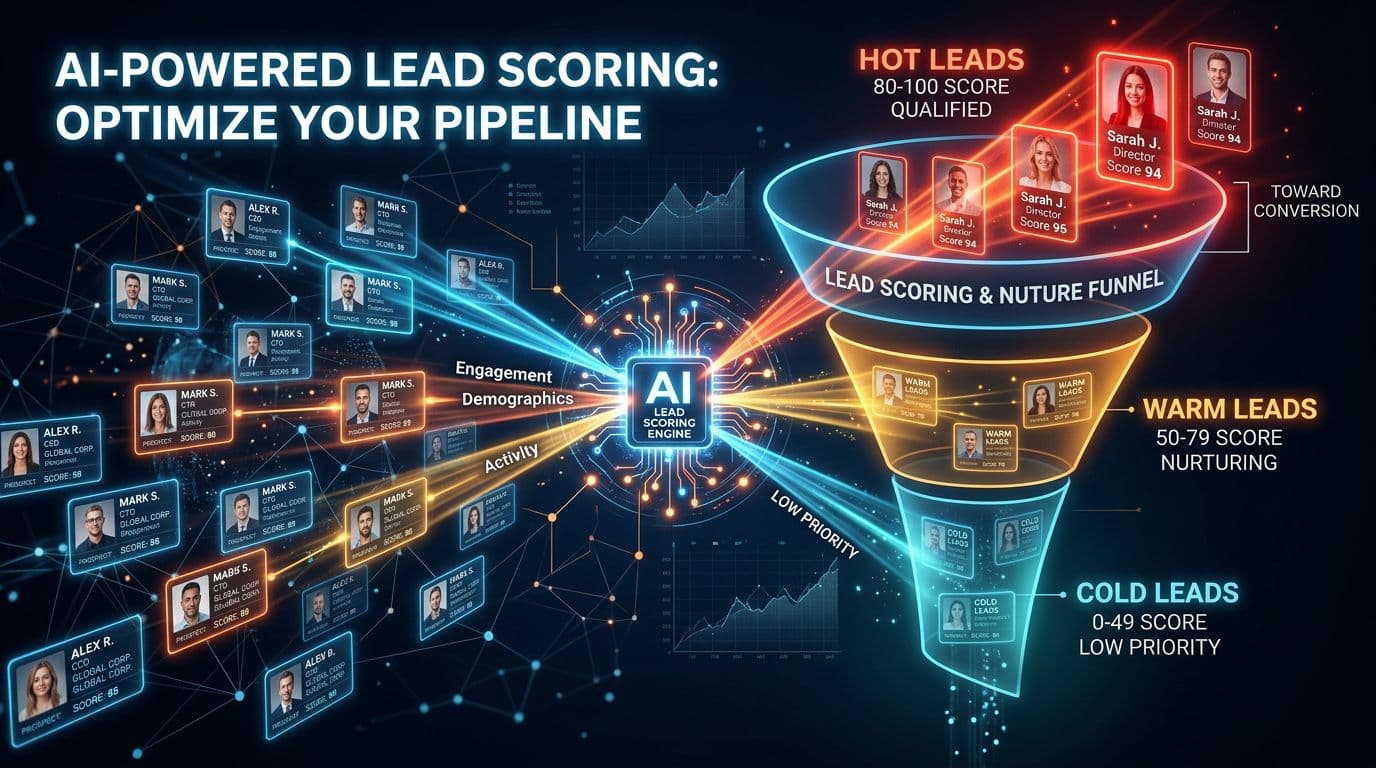
Every sales team has the same problem: too many leads and not enough time. Studies consistently show that sales reps waste up to 67% of their time chasing leads that will never convert. They send follow-ups into the void, schedule calls with tire-kickers, and spend hours crafting proposals for prospects who were never going to buy.
The result? Burnout, missed quotas, and a pipeline full of dead weight.
AI-powered lead scoring changes the equation entirely. Instead of treating every lead like a potential deal, AI analyzes behavioral patterns, engagement signals, and predictive indicators to tell you exactly which leads deserve your attention — and which ones should be left to automated nurture sequences.
Here's how it works, why it matters, and how to implement it without blowing up your current process.
The Real Cost of Treating All Leads Equally
Most sales teams operate on a first-in, first-out basis. A new lead comes in, someone picks it up, and they work it until it closes or dies. The problem is that this approach treats a VP of Sales who replied to your email in 12 minutes the same as someone who accidentally filled out a form and never opened a single message.
The numbers are brutal. According to research from multiple sales organizations:
- Only 25% of leads are legitimate and should advance to sales
- Sales reps spend an average of 8 hours per week on leads that go nowhere
- 79% of marketing leads never convert due to lack of proper qualification
- Companies that excel at lead scoring generate 50% more sales-ready leads at 33% lower cost
The math is simple. If your team has 500 leads and only 125 are real opportunities, every minute spent on the other 375 is a minute stolen from deals that could actually close.
Traditional Lead Scoring vs. AI-Powered Scoring
Traditional lead scoring uses static rules. You assign points based on demographic criteria — job title gets 10 points, company size over 100 employees gets 15 points, downloaded a whitepaper gets 5 points. When a lead crosses a threshold, they're marked as "qualified."
The problem is that these rules are backward-looking. They're based on what your team thinks matters, not what actually predicts conversion. A CEO at a 500-person company looks great on paper, but if they haven't opened a single email in three weeks, they're not a hot lead. Meanwhile, a mid-level manager at a 50-person company who has replied to every message, asked about pricing, and visited your website four times this week is practically begging to buy.
AI-powered scoring is fundamentally different. Instead of static rules, it analyzes patterns across thousands of data points in real time:
- Behavioral signals: How quickly do they respond? What do they say? Do they engage across multiple channels?
- Engagement velocity: Are they becoming more engaged over time, or cooling off?
- Sentiment analysis: Are their responses positive, neutral, or brushing you off?
- Timing patterns: When do they engage? Are they looking at your content during business hours or at 11pm on a Sunday (a strong buying signal)?
- Company fit: Does their organization match the profile of your best customers?
- Conversation quality: Are they asking questions about implementation, pricing, and timelines — or just kicking tires?
The key difference is that AI scoring is dynamic. It updates in real time as new signals come in, so a lead's score yesterday might be completely different from their score today based on how they've interacted with your outreach.
The Signals That Actually Predict Conversion
After analyzing millions of sales conversations across channels, certain patterns consistently predict whether a lead will convert. Here are the ones that matter most:
High-Intent Signals (Score Boosters)
Response speed is the single strongest predictor of conversion. A lead who replies to your email within an hour is 7x more likely to convert than one who takes three days. AI tracks response latency across every touchpoint and adjusts scores accordingly.
Multi-channel engagement is the second strongest signal. When a lead responds to your email, then replies to an SMS follow-up, then answers a phone call — that's a prospect who is actively engaged. Each additional channel they interact on increases conversion probability significantly.
Question quality matters enormously. Leads who ask about pricing, implementation timelines, contract terms, or integration capabilities are signaling buying intent. AI can parse these questions from conversation text and weight them appropriately. "How much does it cost?" is worth far more than "Can you send me more information?"
Stakeholder mentions are a hidden gem. When a lead says "I need to loop in my VP" or "Let me check with our team," that's not a brush-off — it's a sign they're taking the conversation seriously enough to involve decision-makers.
Engagement acceleration catches prospects who are warming up. If a lead ignored your first three emails but has now opened the last five in a row and clicked through twice, their trajectory matters more than their historical average.
Low-Intent Signals (Score Reducers)
Not every signal is positive. AI scoring is equally powerful at identifying leads who should be deprioritized:
Declining engagement is the most obvious red flag. A lead who was responsive two weeks ago but has gone dark is cooling off. Their score should drop accordingly.
Vague or deflecting responses signal low intent. Replies like "maybe later," "send me some info," or "we're not looking right now" are polite ways of saying no. AI can detect these patterns and reduce scores automatically.
Bounced or invalid contact information is a clear disqualifier. If emails bounce, phone numbers are disconnected, or SMS messages fail to deliver, the lead is either fake or unreachable.
Competitor mentions can go either way, but when a lead says "we're already using [competitor] and happy with it," that's a strong negative signal.
Extended silence after meaningful touchpoints is telling. If you sent a detailed proposal and heard nothing for two weeks, the deal is likely dead regardless of how promising it looked earlier.
How AI Scoring Works in Real Time
The real power of AI scoring is that it never stops evaluating. Here is what happens behind the scenes as your AI sales agent works a lead:
1. Initial scoring on entry. When a lead enters your system — whether from a form fill, a cold list import, or a referral — AI immediately scores them based on available data. Company size, industry, job title, and any other firmographic data create a baseline score.
2. Engagement-based adjustments. Every interaction updates the score. An email open adds a small amount. A reply adds more. A positive reply with buying signals adds significantly. A negative reply or unsubscribe request drops the score dramatically.
3. Conversation analysis. As your AI agent has multi-turn conversations with leads via email, SMS, or voice, natural language processing extracts intent signals from every message. The AI doesn't just track if someone replied — it understands what they said and how they said it.
4. Cross-channel correlation. AI connects the dots across channels. If a lead receives an email, doesn't reply, but then visits your website and looks at the pricing page, those signals are combined into a unified score. Channel-hopping often indicates a prospect doing their homework before reaching out.
5. Decay and freshness. Scores aren't static. If a previously hot lead goes quiet, their score gradually decays over time. This prevents your team from chasing leads based on engagement that happened weeks or months ago.
The Qualification Framework: MQL to SQL to Opportunity
AI scoring feeds directly into a qualification framework that automatically segments your pipeline:
Marketing Qualified Lead (MQL)
Score range: 30-59. These leads have shown initial interest — they've engaged with content, opened emails, or filled out a form. They're real people at real companies, but they haven't demonstrated buying intent yet. AI action: Continue automated nurture sequences. Send educational content. Monitor for score increases.
Sales Qualified Lead (SQL)
Score range: 60-84. These leads have demonstrated genuine interest. They've had meaningful conversations, asked substantive questions, or engaged across multiple channels. AI action: Prioritize for human follow-up. Alert sales team. Accelerate outreach cadence.
Opportunity
Score range: 85+. These leads are showing strong buying signals. They're asking about pricing, discussing implementation, mentioning timelines, or involving other stakeholders. AI action: Immediate human handoff. Schedule demo or meeting. Full sales team engagement.
The beauty of this framework is that AI handles the sorting automatically. Your sales team doesn't need to manually review hundreds of leads to figure out who's worth calling. The system surfaces the hottest opportunities and lets AI nurture everything else until it's ready.
Intent Signals Across Channels
Different channels reveal different types of intent, and AI scoring weighs them accordingly:
Email signals: Open rates, click-through rates, reply sentiment, forward-to-colleague behavior, time-to-open, and the content of replies. A lead who forwards your email to a colleague is worth more than one who simply opens it.
SMS signals: Reply speed (SMS replies are typically faster and more candid than email), message length, emoji usage (positive sentiment indicator), and question-asking behavior. SMS conversations tend to be more authentic, making them a rich source of intent data.
Voice signals: Call duration, talk-to-listen ratio, questions asked during the call, next-step commitments, and whether the lead called back after a missed call. A 15-minute phone conversation where the lead asks eight questions is a radically different signal than a 2-minute call where they say "I'm not interested."
Website signals: Page visits, time on site, specific pages viewed (pricing pages are gold), return visits, and content downloads. A lead who visits your pricing page three times in a week is telling you something important.
AI scoring combines all of these signals into a single, continuously updated score that gives your team a real-time picture of where every lead stands.
How Scoring Changes Your Sales Team's Workflow
Implementing AI scoring doesn't just add a number to each lead — it fundamentally transforms how your team spends their time.
Before AI scoring: Sales reps start each morning with a list of leads, sorted by date added. They work through the list top to bottom, spending equal time on every lead. They manually try to guess who's ready to buy based on gut feel and incomplete information.
After AI scoring: Sales reps start each morning with a prioritized dashboard. The hottest leads — the ones showing real buying signals right now — are at the top. They spend their first hours on the leads most likely to close. The rest are handled by AI-powered nurture sequences that continue building relationships automatically.
The impact on daily workflow is dramatic:
- Morning huddles focus on the top 10-15 highest-scoring leads rather than reviewing the entire pipeline
- Follow-up sequences are personalized based on score — hot leads get phone calls, warm leads get targeted emails, cold leads get automated nurture
- Time allocation shifts from 30% selling / 70% qualifying to 70% selling / 30% qualifying
- Handoff timing is optimized — AI nurtures leads until they're genuinely ready, then hands them to a human at the perfect moment
Implementation: Getting Started Without Disrupting Your Process
You don't need to rip out your existing sales process to implement AI scoring. Here's a phased approach:
Phase 1: Shadow scoring (Week 1-2). Turn on AI scoring in observation mode. Let it score your existing leads without changing any workflows. Compare AI scores against your team's gut instincts. You'll quickly see where the AI identifies opportunities your team missed — and where it flags leads your team is wasting time on.
Phase 2: Alert integration (Week 3-4). Start using AI scores to trigger alerts. When a lead crosses the SQL threshold, notify the assigned rep. When a lead's score spikes (indicating sudden engagement), send a real-time alert. Don't change lead assignment or workflow yet — just add the intelligence layer.
Phase 3: Priority routing (Month 2). Begin routing leads based on AI scores. Hot leads go directly to your best closers. Warm leads enter automated nurture sequences with human checkpoints. Cold leads are handled entirely by AI until their behavior warrants human attention.
Phase 4: Full integration (Month 3+). AI scoring drives your entire pipeline. Lead assignment, follow-up cadence, channel selection, and handoff timing are all informed by real-time scores. Your team focuses exclusively on high-probability opportunities while AI manages everything else.
The ROI: What AI Scoring Actually Delivers
Teams that implement AI-powered lead scoring consistently see measurable improvements across key metrics:
- 2-3x improvement in meeting quality: When your team only meets with high-scoring leads, close rates increase dramatically because every meeting is with someone who actually wants to buy
- 40-60% reduction in time wasted on unqualified leads: AI handles the qualification that used to consume most of your team's day
- 30% faster sales cycles: By engaging leads at the right moment with the right message, deals move through the pipeline faster
- 50% more pipeline from the same lead volume: Leads that would have been ignored or dropped are nurtured by AI until they're ready, capturing opportunities your team would have missed
The compound effect is powerful. When your best salespeople spend their time exclusively on the best leads, while AI nurtures everything else in the background, you get more output from the same team without adding headcount.
The Bottom Line
Sales teams don't have a lead problem — they have a prioritization problem. The leads are there. The opportunities are there. But when every lead gets the same amount of attention regardless of their likelihood to buy, the math simply doesn't work.
AI-powered lead scoring solves the prioritization problem at scale. It watches every signal, analyzes every interaction, and continuously updates its assessment of which leads are worth your team's time right now. The leads that aren't ready yet don't get abandoned — they get nurtured by AI until they are.
The result is a sales team that spends less time guessing and more time closing. That's not a marginal improvement — it's a fundamental shift in how modern sales teams operate.
Stop treating all leads equally. Start letting AI tell you which ones are actually worth your time.
Written by
Rocket Agents Team
Part of the Rocket Agents team, helping businesses convert more leads into meetings with AI-powered sales automation.
Ready to Convert More Leads?
See how Rocket Agents can help you respond to leads instantly and book more meetings.