Back to News
How Small Businesses Are Using AI to Compete with Enterprise Sales Teams
Rocket Agents Team
March 20, 2026
#small-business#smb-sales#ai-sales-automation#enterprise-vs-smb#sales-scaling

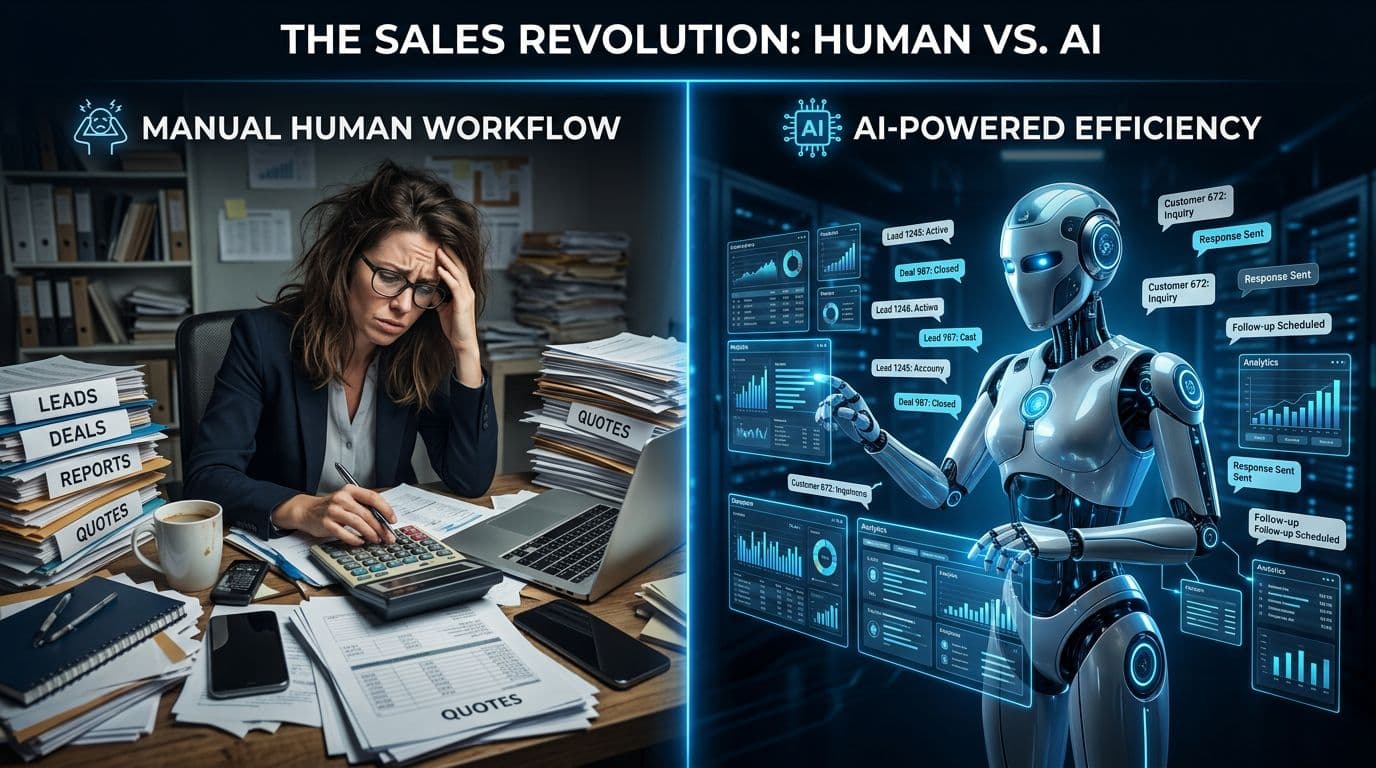
Every small business owner knows the feeling. You're up against a competitor with a 20-person sales team, a dedicated SDR squad, and a CRM budget that could cover your entire payroll. They're running multi-channel outreach campaigns, following up with leads within minutes, and booking meetings around the clock. Meanwhile, you're answering sales inquiries between client calls, sending follow-up emails at midnight, and watching hot leads go cold because you simply couldn't get back to them fast enough.
For decades, this was just the cost of being small. Enterprise companies had the resources. You had the hustle. And hustle, while admirable, doesn't scale.
But something has shifted. AI-powered sales automation is rewriting the rules of engagement, and for the first time, small businesses can compete with enterprise sales teams on reach, speed, and consistency -- without the enterprise budget.
The Small Business Sales Disadvantage
Let's be honest about what small business owners are up against.
The average enterprise sales team has clear role separation: SDRs handle prospecting, AEs manage deals, and customer success reps handle post-sale relationships. Each person focuses on one thing and does it well. They have sophisticated tech stacks, dedicated ops people to manage them, and the budget to experiment with new channels.
Small business owners? They're the CEO, the salesperson, the account manager, and often the one delivering the service. A roofing company owner is climbing on roofs during the day and trying to follow up with leads at night. An insurance agent is meeting clients, filing paperwork, and somehow supposed to be prospecting for new business simultaneously. A real estate agent is showing houses, negotiating contracts, and trying to nurture a pipeline of future buyers all at once.
The math simply doesn't work. There are only so many hours in a day, and when you're wearing every hat in the business, sales outreach is usually the first thing that gets pushed to "I'll get to it later." The problem is, "later" in sales usually means "too late."
Studies consistently show that responding to a lead within five minutes makes you 21 times more likely to qualify them compared to waiting 30 minutes. Enterprise teams have systems that ensure sub-five-minute response times. Small businesses are lucky if they can respond the same day.
This isn't a character flaw. It's a structural disadvantage. And until recently, the only solution was to hire -- which creates its own set of problems.
The Hiring Trap
The traditional answer to "I need more sales capacity" has always been "hire a salesperson." But let's look at what that actually means for a small business.
A competent SDR or sales rep costs a minimum of $50,000-$70,000 per year in salary alone. Add benefits, payroll taxes, equipment, software licenses, and management overhead, and you're looking at $80,000-$100,000 annually. That's before they've booked a single meeting.
Then there's the ramp-up period. It takes most sales reps three to six months to become fully productive. During that time, you're paying full salary for partial output. And if the hire doesn't work out -- which happens roughly 50% of the time in sales roles -- you're back to square one, minus several months of salary and the opportunity cost of all the leads that weren't properly worked.
For a business doing $500,000 to $2 million in annual revenue, a single bad sales hire can be genuinely threatening. It's not just the money; it's the distraction, the management burden, and the emotional toll of building a team when you're still trying to build the business.
This is why so many small business owners stay trapped in the "I'll just do it myself" cycle. The risk of hiring feels too high, but the cost of not scaling feels equally unsustainable.
How AI Changes the Equation
AI-powered sales automation doesn't replace the need for human judgment, relationship-building, or expertise. What it does is handle the repetitive, time-consuming, high-volume work that buries small business owners -- the work that enterprise teams solve by throwing bodies at the problem.
Here's what that looks like in practice:
Instant lead response, 24/7. When a lead fills out a form on your website at 9 PM on a Saturday, an AI agent can engage them within seconds via SMS, email, or even voice. It can qualify them, answer common questions, and book a meeting on your calendar -- all while you're at your kid's soccer game. The lead gets a professional, immediate response. You get a qualified meeting on your calendar for Monday morning.
Multi-channel outreach at scale. Instead of manually sending follow-up emails or texts one by one, AI can run coordinated outreach campaigns across email, SMS, and voice. It personalizes each message based on what it knows about the lead, follows up at optimal intervals, and adjusts its approach based on how the lead responds. One small business owner can effectively run outreach that would normally require a team of five to ten SDRs.
Consistent follow-up that never drops the ball. The number one reason small businesses lose deals isn't price or competition -- it's simply failing to follow up. AI doesn't forget. It doesn't get busy with other things. It follows up on the schedule you set, every single time, with every single lead. No one falls through the cracks.
Intelligent qualification. Not every lead is worth your time. AI can ask qualifying questions, score leads based on their responses, and route only the most promising opportunities to you. Instead of spending your limited selling time on tire-kickers, you're talking to people who are ready to buy.
The Cost Reality
Let's put real numbers on this.
An AI sales automation platform typically costs between $200 and $500 per month, depending on volume and features. For the sake of comparison, let's use $400 per month -- $4,800 per year.
A single entry-level sales hire costs approximately $60,000 per year in salary, plus $15,000-$25,000 in benefits and overhead. Call it $80,000 all-in.
That means AI costs roughly 6% of what a single hire costs -- and it works 24 hours a day, 7 days a week, 365 days a year without vacation, sick days, or turnover.
But the comparison isn't entirely apples-to-apples, and that's important to acknowledge. An AI platform isn't going to close a complex B2B deal or build deep personal relationships with key accounts. That's still your job, and it should be. What AI does is multiply your effectiveness by handling everything that leads up to the conversation -- the prospecting, the initial outreach, the follow-up, the qualification, the scheduling.
Think of it this way: instead of spending 70% of your time on outreach and follow-up and 30% on actual selling, AI flips that ratio. You spend 80% of your time in real conversations with qualified prospects and 20% on strategy and oversight. That's the same leverage that enterprise sales teams get from having dedicated SDR teams -- at a fraction of the cost.
Industries Where This Matters Most
While AI sales automation can benefit virtually any business that relies on lead generation and outreach, certain industries are seeing outsized impact.
Real Estate
Real estate agents live and die by their responsiveness. When a buyer inquires about a property, they're often contacting multiple agents simultaneously. The first one to respond meaningfully usually wins the relationship. AI gives solo agents and small brokerages the ability to respond instantly to every inquiry, nurture long-term buyers who aren't ready to purchase yet, and re-engage past clients automatically. An agent who previously maxed out at managing 30 active leads can now effectively nurture hundreds.
Insurance
Insurance is a relationship and volume game. Independent agents compete against large agencies with dedicated sales teams. AI allows independent agents to run automated outreach to expiring policies, follow up on quote requests instantly, and maintain regular touchpoints with their book of business. The agent who reaches out proactively at renewal time -- before the competition does -- wins the business. AI makes that possible even when you're a one-person shop.
Home Services
Roofing companies, HVAC contractors, plumbers, and electricians face a unique challenge: their best salespeople are often out in the field doing the actual work. When a homeowner requests a quote, they might not hear back for hours or even days. By then, they've already called three other contractors. AI can respond to every inquiry immediately, pre-qualify the job (type of service, urgency, property details), and schedule the estimate -- all while the crew is on a job site.
Marketing and Creative Agencies
Agency owners frequently struggle with the feast-or-famine cycle. When they're delivering client work, they're not selling. When they're selling, client work suffers. AI handles the top of the funnel consistently, ensuring a steady stream of qualified prospects even during heavy delivery periods. It can also re-engage past prospects who went dark and nurture referral relationships automatically.
Coaching and Consulting
Coaches and consultants sell their time, which creates an inherent conflict: the more time they spend selling, the less time they have to deliver. AI handles the entire top-of-funnel process -- responding to inquiries, sharing relevant content, qualifying prospects based on budget and needs, and booking discovery calls. The coach shows up to calls that are already pre-qualified, dramatically improving close rates and reducing wasted time.
The Founder Who Became a Sales Team
Consider a scenario that plays out thousands of times across the country. A commercial cleaning company founder has grown the business to $1.2 million in annual revenue through referrals and his own sales efforts. He knows he needs to grow to $2 million to hit his financial goals, but he's already stretched thin. He's managing crews, handling client relationships, bidding on new contracts, and doing his own outreach.
He tried hiring a salesperson once. After four months and $25,000 in salary, the rep had booked exactly three meetings, two of which were no-shows. He let the rep go and went back to doing it himself.
Then he implemented AI sales automation. He uploaded his prospect list of facility managers and property management companies. The AI began sending personalized email and SMS sequences, following up automatically, and booking meetings directly on his calendar. Within the first month, he had 14 qualified meetings booked -- more than his previous hire generated in four months.
The key wasn't just the volume. It was the consistency. Every lead got followed up with. Every inquiry got an immediate response. Every prospect received a professional, personalized touchpoint at the right interval. The AI didn't have good days and bad days. It just executed, relentlessly.
Six months later, his pipeline had more qualified opportunities than he could handle -- which, for the first time, created a genuine reason to hire. But now he was hiring a closer to handle warm, pre-qualified leads, not an SDR to cold prospect. The role was more defined, more likely to succeed, and easier to fill.
Another Scenario: The Insurance Agent Who Never Sleeps
An independent insurance agent in a mid-size market is competing against State Farm, Allstate, and other large agencies that have multiple agents and support staff. She's one person with an assistant, and she's good at what she does -- her close rate on conversations is excellent. The problem is getting enough conversations.
She set up AI-powered outreach targeting homeowners whose policies are coming up for renewal in the next 60 days. The AI sends a friendly, personalized message via email and SMS, offers a free rate comparison, and books a call if the homeowner is interested.
Previously, she could manually reach out to maybe 20 people per week. With AI handling the outreach and follow-up, she's now reaching 200 per week. Her calendar stays full, and she's spending her time doing what she does best -- having conversations and closing business -- instead of grinding through manual outreach.
The result? She's writing 40% more policies than the previous year, with the same team size. Her competitors with five-person sales teams aren't growing any faster.
The "Always-On" Advantage
One of the most underappreciated advantages of AI sales automation is coverage during the hours when small businesses are traditionally dark.
Enterprise companies with national or global sales teams can staff around the clock. Someone is always available to respond. Small businesses can't afford that luxury. But leads don't stop coming in at 5 PM. In fact, many studies show that a significant portion of online inquiries happen during evenings and weekends -- precisely when small businesses are offline.
AI changes this completely. A lead who fills out a form at 10 PM gets an immediate, intelligent response. A prospect who texts back on a Sunday morning gets a reply within seconds. A website visitor who has questions at 6 AM before work gets answers, not a voicemail.
This matters enormously in industries where timing is everything. In real estate, the weekend is prime time for buyer activity. In home services, homeowners often research contractors in the evening after work. In insurance, people compare quotes when they're not at their day jobs.
The business that responds at 10 PM on a Tuesday wins over the business that responds at 9 AM on Wednesday. Every time. AI makes small businesses competitive during these critical off-hours without requiring anyone to actually be at their desk.
What Makes This Different From Previous "Solutions"
Small business owners are understandably skeptical of technology promises. They've been told that CRMs would solve everything, that marketing automation would generate leads on autopilot, and that chatbots would handle customer service. Most of these tools ended up being expensive shelf-ware that required more time to manage than they saved.
Modern AI sales automation is different in several important ways.
It's genuinely autonomous. Unlike traditional automation that follows rigid if-then rules, AI can hold real conversations. It understands context, responds appropriately to questions, handles objections, and adapts its approach based on the lead's responses. This isn't a chatbot that says "I don't understand, let me connect you with a representative." It's an AI that can actually advance a conversation toward a meeting.
It works across channels. Real sales conversations don't happen on a single channel. A lead might receive an email, reply via text, and eventually want a phone call. AI orchestrates across all of these channels seamlessly, maintaining context and continuity regardless of how the prospect prefers to communicate.
It learns and improves. The more conversations AI has, the better it gets at qualifying leads, handling objections, and booking meetings in your specific industry and market. It's not static -- it continuously improves based on what works.
It requires minimal management. You don't need a dedicated ops person or a tech-savvy marketing manager to run it. Set up your ideal customer profile, define your qualifying criteria, and let the AI work. Check in on results, refine your approach, and focus your human time on the conversations that matter.
The Shift Is Already Happening
The small businesses that are adopting AI sales automation today are gaining a compounding advantage. Every month they run AI-powered outreach, they're building pipeline, booking meetings, and growing revenue while their competitors are still stuck in the manual grind.
This isn't about replacing the human element of sales. The best small business owners succeed because of their expertise, their relationships, and their genuine care for their customers. AI doesn't replace any of that. It amplifies it by ensuring that more of the right people get to experience it.
The playing field between small businesses and enterprise sales teams will never be perfectly level. Enterprise companies will always have more resources, more budget, and more people. But AI has narrowed the gap dramatically. A small business owner with the right AI tools can now generate the same volume and quality of sales conversations that used to require a team of five to ten people.
The question isn't whether small businesses will adopt AI for sales. It's whether they'll adopt it fast enough to capture the advantage before it becomes table stakes.
For the small business owner who's tired of watching leads go cold, tired of competing against teams ten times their size, and tired of being the bottleneck in their own growth -- AI sales automation isn't just a nice-to-have. It's the great equalizer.
Written by
Rocket Agents Team
Part of the Rocket Agents team, helping businesses convert more leads into meetings with AI-powered sales automation.

Ready to Convert More Leads?
See how Rocket Agents can help you respond to leads instantly and book more meetings.