
Back to News
Lead Enrichment in 2026: How to Turn a Name Into a Full Sales Profile in Seconds
Rocket Agents Team
March 30, 2026
#lead-enrichment#data-enrichment#sales-intelligence#personalization#b2b-data
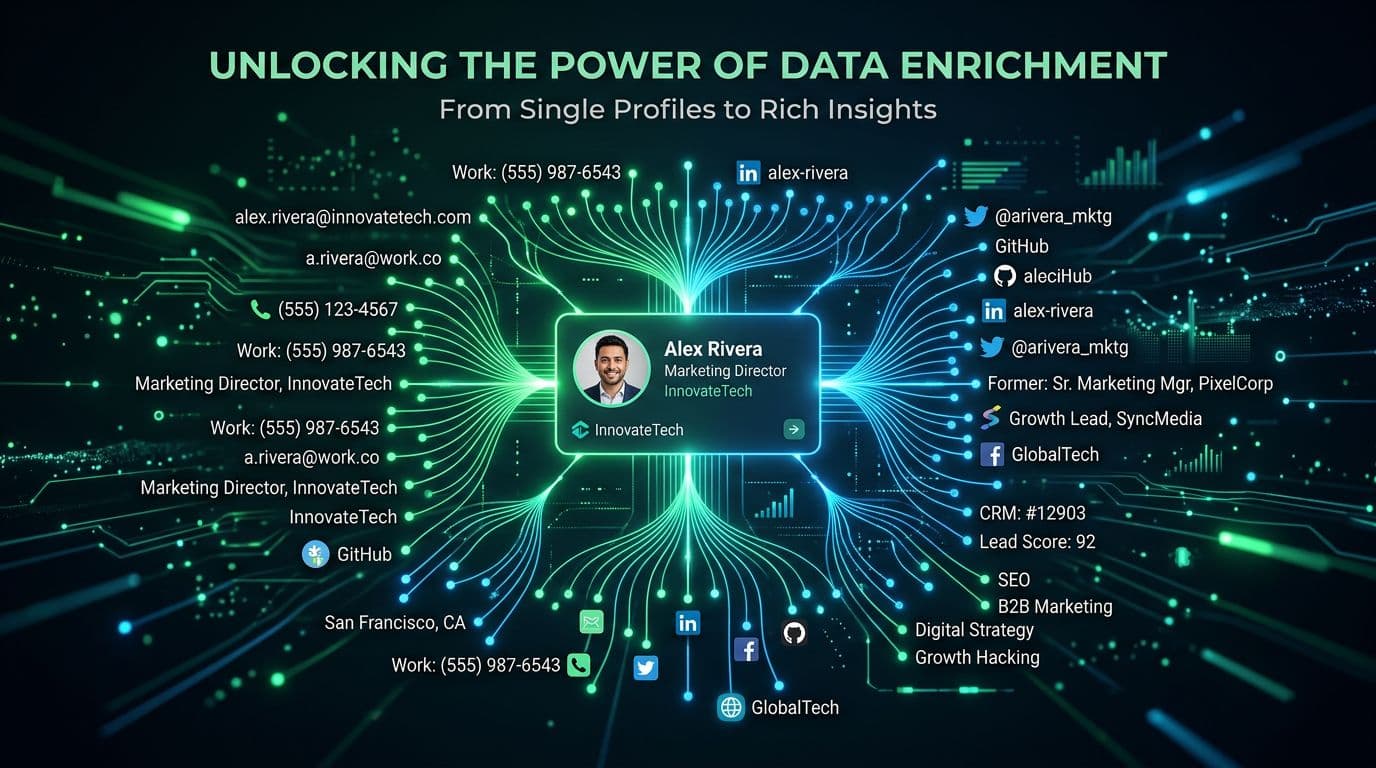
Lead enrichment has become the backbone of modern B2B sales. In a world where buyers expect hyper-relevant outreach and generic cold emails go straight to trash, the ability to transform a bare name into a complete sales profile is no longer a luxury — it is a necessity.
This guide covers everything you need to know about lead enrichment in 2026: what it is, how it works, why data quality matters more than data quantity, and how the best sales teams are using enrichment to power personalized outreach at scale.
What Is Lead Enrichment?
Lead enrichment is the process of taking a basic data point — typically a name, email address, or LinkedIn URL — and augmenting it with additional information to create a complete prospect profile. That additional information might include:
- Verified email addresses (both personal and work)
- Direct phone numbers and mobile numbers
- Job title, seniority, and department
- Company name, size, industry, and revenue
- Social media profiles (LinkedIn, Twitter/X)
- Location and timezone
- Technology stack the company uses
- Recent news, funding rounds, or job changes
The goal is simple: give your sales team (or your AI sales agent) enough context to craft outreach that feels personal, relevant, and timely — without requiring hours of manual research per prospect.
The Old Way: Manual Research and Stale Lists
Not long ago, enrichment meant one of two things: manual research or purchased lists.
Manual research looked like this: a sales rep finds a prospect on LinkedIn, copies their job title, manually Googles their company, hunts for an email pattern on their website, tries common formats like firstname@company.com, and hopes for the best. A thorough rep might spend 10-15 minutes per lead. At 50 leads per day, that is an entire workday spent on research instead of selling.
Purchased lists were the other option. Companies like ZoomInfo, Lusha, and Apollo built massive databases of business contacts. You could buy lists of thousands of contacts matching your ideal customer profile. The problem? Data decays at roughly 30% per year. People change jobs, companies rebrand, phone numbers go stale. By the time you bought a list and loaded it into your CRM, a significant chunk was already outdated.
Both approaches shared the same fundamental flaw: they treated enrichment as a one-time event rather than an ongoing process. And both were painfully slow.
Modern Enrichment: Speed, Accuracy, and Automation
Modern lead enrichment is built on APIs, automation, and intelligent orchestration. Here is how it works in practice.
Real-Time API Lookups
Instead of relying on static databases, modern enrichment tools query multiple data sources in real time. When you submit a LinkedIn URL or email address, the system reaches out to specialized providers that each maintain their own data collection methods:
- Email finders crawl the web, analyze email patterns, and verify deliverability in real time
- Phone lookup services aggregate data from public records, business directories, and proprietary sources
- Social profile matchers connect names and emails to LinkedIn, Twitter/X, and other professional profiles
- Company data providers pull firmographic information from business registrations, news feeds, and web scraping
The result? What used to take 15 minutes of manual research now happens in seconds.
The LinkedIn URL as a Starting Point
In B2B sales, the LinkedIn profile has become the universal identifier. A single LinkedIn URL can unlock an enormous amount of data:
- Name parsing — Full name, often including middle names and suffixes
- Current position — Job title, company, start date
- Career history — Previous roles, companies, and tenure
- Education — Schools, degrees, graduation years
- Skills and endorsements — Technical and professional competencies
- Shared connections — Mutual contacts for warm introductions
- Content activity — Posts, articles, and engagement patterns
From this foundation, enrichment APIs can find verified email addresses, direct phone numbers, and company-level data — all without a single manual search.
Why Data Quality Matters More Than Quantity
Here is a truth that too many sales teams learn the hard way: a list of 10,000 unverified contacts is worth less than a list of 500 enriched, verified prospects.
The Cost of Bad Data
Bad data does not just waste time. It actively damages your sales operation:
- Bounced emails hurt your sender reputation, making future emails more likely to land in spam
- Wrong phone numbers waste calling hours and frustrate reps
- Outdated job titles lead to irrelevant messaging that gets ignored
- Incorrect company data makes your outreach look lazy and uninformed
Research consistently shows that B2B databases decay at 25-30% annually. That means if you enriched a lead 12 months ago and never refreshed the data, there is roughly a one-in-three chance that at least one critical field is wrong.
Verification Is Not Optional
Modern enrichment is not just about finding data — it is about verifying it. A good enrichment pipeline includes:
- Email verification — SMTP checks, catch-all detection, and deliverability scoring
- Phone validation — Line type detection (mobile vs. landline vs. VoIP), carrier lookup, and connection status
- Recency checks — How recently was this data confirmed? Is the person still at this company?
Without verification, you are just adding more noise to your CRM.
How Waterfall Enrichment Solves the Coverage Problem
No single data provider has complete coverage. Provider A might have great email data for enterprise companies but poor coverage for startups. Provider B might excel at phone numbers in North America but struggle with European contacts. Provider C might have the freshest data but the smallest database.
Waterfall enrichment solves this by querying multiple providers in sequence. Here is how it works:
- Start with Provider A — If it returns a verified result, stop. You have your data.
- If Provider A misses, try Provider B — Different data sources, different coverage.
- If Provider B misses, try Provider C — Cast a wider net.
- Continue until you get a result or exhaust all providers.
This approach dramatically improves hit rates. While a single provider might find an email address 60-70% of the time, a waterfall across three or four providers can push that to 85-95%.
Intelligent Routing
The best enrichment systems go beyond simple waterfalls. They use intelligent routing based on what they know about the lead:
- Industry-based routing — Certain providers perform better in specific industries
- Geography-based routing — Some providers have stronger coverage in certain regions
- Company size routing — Enterprise vs. SMB coverage varies significantly by provider
- Data type routing — The best email provider is rarely the best phone provider
By routing leads to the providers most likely to have accurate data for that specific profile, you reduce costs (fewer API calls) and improve quality (higher verification rates).
Caching for Cost Efficiency
Smart enrichment systems also cache results. If you already enriched a prospect six months ago and their LinkedIn shows no job change, there is no reason to burn another API credit re-enriching them. A good cache system:
- Stores raw provider responses alongside parsed data
- Checks the cache before making any external API call
- Tracks cache age and triggers re-enrichment when data might be stale
- Distinguishes between cache hits and fresh lookups for billing accuracy
This can reduce enrichment costs by 30-50% for teams that frequently re-encounter the same prospects across different campaigns.
Powering Personalization at Scale
Enriched data is only valuable if you use it. And the highest-value use case is personalization at scale.
Beyond First Name Tokens
Everyone has received an email that says "Hi {firstName}, I noticed you work at {company}." That is not personalization — that is mail merge. Real personalization requires deeper context:
- Role-specific messaging — A VP of Sales cares about different things than a Director of Marketing
- Company-stage relevance — A Series A startup has different priorities than a Fortune 500
- Industry context — Healthcare prospects have different compliance concerns than fintech prospects
- Trigger events — A recent job change, funding round, or product launch creates timely hooks for outreach
How AI Uses Enriched Data
Modern AI sales agents consume enriched data to generate truly personalized outreach. With a complete profile, an AI agent can:
- Select the right messaging angle based on the prospect's role, industry, and company size
- Reference specific context like recent company news, shared connections, or career trajectory
- Choose the optimal channel — some prospects respond better to email, others to SMS or LinkedIn
- Time the outreach based on the prospect's timezone and typical engagement patterns
- Adapt follow-ups based on how the prospect has engaged (or not) with previous touches
The difference between a generic AI email and an AI email powered by rich enrichment data is the difference between spam and a genuine conversation starter.
Multi-Channel Outreach
Enrichment enables true multi-channel sequences. With a verified email, a direct phone number, and a LinkedIn profile, your outreach can flow across channels:
- Day 1: Personalized email referencing their recent LinkedIn post
- Day 3: SMS follow-up with a concise value proposition
- Day 5: LinkedIn connection request with a custom note
- Day 7: Phone call with context from all previous touches
Without enrichment, you are limited to whatever single channel you found them on. With enrichment, you meet prospects where they are.
Privacy and Compliance: Getting It Right
Lead enrichment operates in a complex regulatory landscape. Two major frameworks govern how you can collect, store, and use personal data:
GDPR (European Union)
The General Data Protection Regulation applies to any prospect based in the EU, regardless of where your company is located. Key requirements:
- Lawful basis — You need a legal basis for processing personal data. For B2B sales outreach, this is typically "legitimate interest," but you must document your reasoning.
- Data minimization — Only collect data you actually need for your stated purpose.
- Right to erasure — Prospects can request that you delete their data, and you must comply within 30 days.
- Transparency — Your privacy policy must explain what data you collect and how you use it.
CCPA / CPRA (California)
The California Consumer Privacy Act (and its successor, CPRA) gives California residents similar rights:
- Right to know — Consumers can request what data you have about them.
- Right to delete — Similar to GDPR's right to erasure.
- Right to opt out — Consumers can opt out of the "sale" or "sharing" of their personal information.
- Do Not Sell — You must honor opt-out requests and provide a clear mechanism to submit them.
Best Practices for Compliant Enrichment
- Document your legitimate interest — Write down why enriching this data serves a genuine business purpose
- Honor opt-outs immediately — When someone says stop, stop. Update suppression lists in real time.
- Minimize data retention — Do not hoard data you are not actively using. Set retention policies and enforce them.
- Use reputable providers — Your enrichment providers should be compliant themselves. If they scraped data illegally, that liability can flow to you.
- Be transparent in outreach — Tell prospects how you found their information if asked. Honesty builds trust.
- Maintain suppression lists — Keep centralized lists of people who have opted out, and check them before every outreach.
Compliance is not just about avoiding fines. It is about building a sales operation that prospects respect and trust.
The Enrichment-to-Outreach Pipeline
The real power of modern enrichment is not the data itself — it is the pipeline it enables. The best sales teams in 2026 have built seamless workflows that go from raw lead to personalized outreach in a single automated flow.
Step 1: Capture
Leads enter the system from multiple sources: website forms, LinkedIn searches, event attendees, inbound inquiries, referrals, or imported lists. At this stage, you might have nothing more than a name and a LinkedIn URL.
Step 2: Enrich
The enrichment engine kicks in automatically. Within seconds, the system:
- Resolves the LinkedIn profile to extract name, title, company, and career history
- Runs the email through a waterfall of providers to find and verify a business email
- Queries phone databases to find a direct mobile number
- Pulls company data: size, industry, revenue, technology stack, recent news
Step 3: Score and Qualify
With enriched data, the system can automatically score and qualify leads:
- Does this person match your ideal customer profile (ICP)?
- Is their company the right size and industry?
- Do they have the authority to make purchasing decisions?
- Are there any disqualifying factors (competitor, existing customer, wrong geography)?
Low-quality leads are filtered out before they ever reach a sales rep, saving time and improving conversion rates.
Step 4: Personalize
An AI engine uses the enriched profile to generate personalized messaging:
- Crafts email copy that references the prospect's specific role, company, and context
- Writes SMS messages that are concise and relevant
- Prepares talking points for phone calls
- Selects the right case studies, social proof, and value propositions for this specific prospect
Step 5: Execute
The outreach fires automatically across multiple channels, timed to the prospect's timezone and optimized based on historical engagement data. The AI agent handles responses in real time — answering questions, handling objections, and booking meetings directly on the sales rep's calendar.
The Result
What used to be a multi-day process involving manual research, CRM data entry, email drafting, and follow-up scheduling now happens in seconds. A name becomes a profile. A profile becomes a personalized message. A message becomes a conversation. A conversation becomes a meeting.
What to Look for in an Enrichment Solution
If you are evaluating enrichment tools in 2026, here are the criteria that matter most:
- Coverage breadth — Does it support waterfall enrichment across multiple providers?
- Verification quality — Does it verify emails and phone numbers, or just find them?
- Speed — Can it enrich leads in real time, or does it batch process with delays?
- Integration depth — Does it connect to your CRM, outreach tools, and AI agents?
- Compliance — Does it support GDPR/CCPA compliance, suppression lists, and data retention policies?
- Cost efficiency — Does it cache results and use intelligent routing to minimize API spend?
- Freshness — How current is the data? Does it re-enrich stale records automatically?
Conclusion
Lead enrichment in 2026 is not about collecting more data — it is about collecting the right data, verifying it, and putting it to work instantly. The teams that win are the ones that have built enrichment into the core of their sales workflow: automated, intelligent, and always-on.
The gap between a team that manually researches prospects and a team with automated enrichment is not incremental. It is exponential. One team sends 50 personalized emails a day. The other sends 500. One team books 5 meetings a week. The other books 50.
The technology exists today to turn any name into a complete, verified sales profile in seconds — and to use that profile to generate outreach that actually gets responses. The only question is whether you are using it.
Written by
Rocket Agents Team
Part of the Rocket Agents team, helping businesses convert more leads into meetings with AI-powered sales automation.
Ready to Convert More Leads?
See how Rocket Agents can help you respond to leads instantly and book more meetings.