Back to News
The State of AI in Sales: 10 Predictions for the Rest of 2026
Rocket Agents Team
March 12, 2026
#ai-predictions#sales-trends#2026-trends#future-of-sales#ai-sales
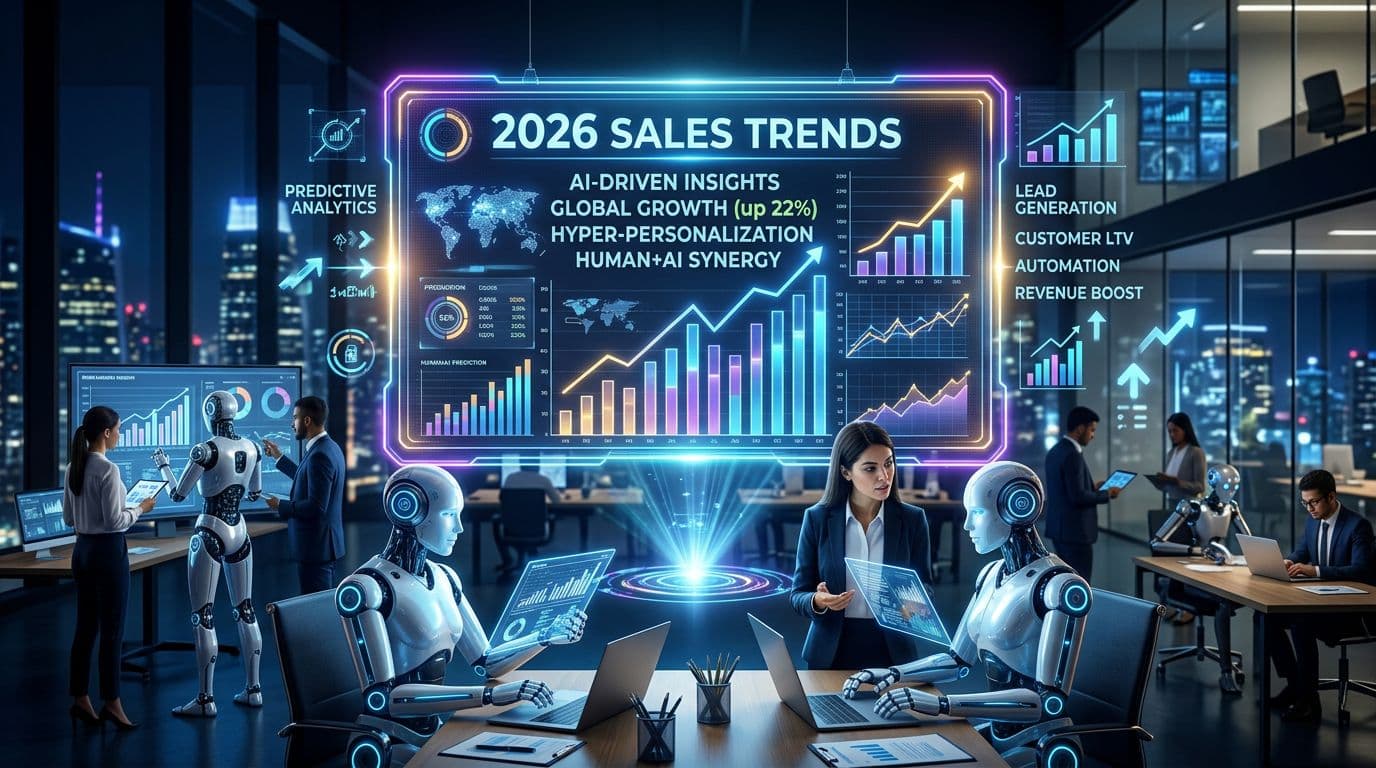
We're barely into the second half of 2026, and the transformation of sales by artificial intelligence has already exceeded even the most aggressive forecasts from two years ago. What was once the domain of early adopters and tech-forward startups has become a full-blown paradigm shift. AI is no longer a "nice to have" in your sales stack --- it's the foundation everything else is built on.
At Rocket Agents, we sit at the intersection of AI innovation and real-world sales execution. We watch the data every day: millions of outbound messages, thousands of booked meetings, and an ever-evolving landscape of tools and techniques. Based on what we're seeing on the ground, here are our 10 predictions for where AI in sales is headed for the rest of 2026.
1. Voice AI Will Become Indistinguishable from Human Callers
The uncanny valley of AI voice is closing fast. Early voice AI solutions suffered from robotic cadence, awkward pauses, and an inability to handle interruptions. Those days are over. By the end of 2026, the best voice AI systems will pass a conversational Turing test with the majority of prospects. Latency has dropped below 300 milliseconds. Emotion detection allows AI callers to adjust tone in real time --- slowing down when a prospect sounds confused, speeding up when they're engaged. Dynamic objection handling now draws from massive datasets of successful sales calls to respond naturally and persuasively. The implications are staggering: companies will be able to run high-quality phone outreach 24/7 without hiring a single cold caller. The ethical questions are real, but the technology is undeniable. Expect regulatory frameworks to start catching up, but not before voice AI fundamentally reshapes how companies think about phone-based sales.
2. AI SDRs Will Outnumber Human SDRs at Companies Under 50 Employees
For small and mid-sized businesses, the math has already flipped. A human SDR costs $50,000--$80,000 per year in salary alone, plus benefits, training, ramp time, and management overhead. An AI SDR costs a fraction of that and works around the clock without sick days, quota complaints, or turnover. By the end of 2026, we predict that the majority of companies with fewer than 50 employees will have more AI SDRs than human ones. This doesn't mean human sales professionals disappear --- it means they move up the funnel. Humans handle relationship-driven closing, complex negotiations, and strategic account management. The repetitive grind of prospecting, initial outreach, and qualification gets handed to AI agents that do it better, faster, and cheaper. Companies that resist this shift will find themselves outpaced by leaner competitors who embraced AI-first sales motions early. The competitive pressure alone will force adoption.
3. Omnichannel AI (SMS + Email + Voice + Social) Becomes Table Stakes
Single-channel outreach is dead. Prospects in 2026 expect --- and respond to --- coordinated outreach across SMS, email, phone, and social platforms. The winning AI sales platforms aren't the ones that do one channel well; they're the ones that orchestrate all channels simultaneously with intelligent sequencing. An AI agent might start with a LinkedIn connection request, follow up with a personalized email, send an SMS two days later, and then make a voice call --- all adapting in real time based on which channels the prospect engages with. This isn't a luxury anymore; it's baseline functionality. Platforms that only offer email automation or standalone dialers will be seen as incomplete. The data backs this up: omnichannel sequences consistently show 3--5x higher response rates compared to single-channel approaches. By Q4 2026, any AI sales tool that doesn't support at least three channels natively will struggle to compete. The market is demanding unified, intelligent orchestration.
4. Personalization at Scale Reaches 1:1 Level via Enrichment + AI
"Hi {first_name}, I noticed you work at {company}" --- that level of personalization is laughably basic now. The new standard is deep, contextual personalization powered by real-time enrichment data and large language models. AI agents now pull from dozens of data sources --- recent LinkedIn posts, company news, funding announcements, job changes, podcast appearances, patent filings, and more --- to craft messages that feel genuinely researched. The result is outreach that reads like a human spent 20 minutes researching the prospect, delivered at the speed and scale of automation. This is the holy grail that sales teams have chased for years: the quality of hand-crafted outreach with the volume of automated campaigns. Enrichment pipelines that feed AI models with fresh, relevant context are becoming the backbone of every serious outreach operation. Companies that still rely on static templates with basic merge fields will see their response rates crater as prospects grow accustomed to hyper-personalized messaging.
5. CRM Data Entry Becomes Fully Automated
Manual CRM updates have always been the bane of every sales rep's existence. Reps spend hours each week logging calls, updating deal stages, and entering notes --- time that could be spent actually selling. By the end of 2026, this pain point will be largely eliminated. AI agents now listen to calls, read email threads, analyze SMS conversations, and automatically update CRM records with accurate, structured data. Call summaries, next steps, deal stage changes, contact information updates, and sentiment analysis all flow into the CRM without a single manual keystroke. The impact on data quality is enormous. When humans are responsible for CRM hygiene, data degrades rapidly --- fields go unfilled, stages go un-updated, and forecasting becomes guesswork. AI-maintained CRMs are consistently more accurate and complete, which in turn makes every downstream process (forecasting, reporting, coaching) dramatically more reliable. Sales leaders who've experienced AI-maintained CRM data will never go back.
6. AI-Driven Lead Scoring Replaces Manual Qualification
Traditional lead scoring --- assigning points based on static criteria like job title, company size, and email opens --- is being replaced by dynamic, AI-driven models that analyze hundreds of signals in real time. These models consider behavioral data (website visits, content engagement, response patterns), firmographic data (company growth rate, tech stack, hiring patterns), and intent data (search behavior, competitor research, review site activity) to produce scores that actually predict conversion. The difference in accuracy is dramatic. Manual scoring models might correctly prioritize 40--50% of leads. AI-driven models are hitting 70--80% accuracy, and improving with every interaction. This means sales teams spend their time on prospects who are genuinely likely to buy, rather than chasing leads that checked a few arbitrary boxes. The shift also enables dynamic re-scoring: a lead that was lukewarm yesterday might spike in priority today based on a new funding round or a job posting that signals buying intent. Real-time scoring means real-time prioritization.
7. Sales Teams Restructure Around AI Augmentation
The traditional sales org chart --- layers of SDRs, AEs, and managers --- is being redesigned from the ground up. Forward-thinking companies are building "AI-augmented" sales structures where each human rep is supported by multiple AI agents handling different aspects of the sales process. Instead of one SDR supporting one AE, you might see one human closer supported by AI agents handling prospecting, initial outreach, qualification, meeting scheduling, follow-up, and CRM management. This fundamentally changes the ratio of revenue per employee and allows smaller teams to punch far above their weight. The management layer is evolving too. Sales managers are becoming "AI orchestrators," spending less time on pipeline reviews and rep coaching, and more time on AI strategy, prompt engineering, and system optimization. The skills required to lead a sales team in 2026 look nothing like they did in 2024. Companies that restructure early will have a massive competitive advantage in hiring, efficiency, and ultimately revenue per head.
8. Compliance Automation Becomes Mandatory (TCPA, GDPR Enforcement Increases)
As AI-powered outreach scales, so does regulatory scrutiny. TCPA enforcement in the United States has intensified dramatically, with per-violation fines increasing and class-action lawsuits becoming more common. GDPR enforcement in Europe continues to tighten, with regulators specifically targeting AI-driven marketing and sales communications. By the end of 2026, compliance automation won't be optional --- it'll be a core feature of any legitimate AI sales platform. This means built-in DNC list checking, automatic consent management, time-zone-aware sending windows, opt-out processing within legally required timeframes, and comprehensive audit trails for every communication. Platforms that treat compliance as an afterthought will face existential legal risk. The companies that win will be the ones that make compliance invisible --- baked into every workflow so that reps and AI agents simply cannot send non-compliant messages. Expect to see "compliance-first" become a major differentiator and selling point for AI sales platforms in the back half of 2026.
9. Meeting-Booked Becomes the Only Metric That Matters
The sales metrics landscape is consolidating around a single north star: meetings booked. Opens, clicks, replies, connection rates --- these have always been vanity metrics that don't directly correlate with revenue. As AI handles more of the top-of-funnel work, the focus is shifting entirely to outcomes. Did the AI book a meeting? Did that meeting happen? Did it convert to pipeline? Everything upstream of the booked meeting is becoming a black box that AI manages autonomously. Sales leaders don't need to know how many emails were sent or what the open rate was --- they need to know how many qualified meetings landed on their closers' calendars this week. This shift has profound implications for how AI sales platforms are built and priced. Pay-per-meeting models are gaining traction over traditional SaaS subscriptions. When the only metric that matters is meetings booked, customers want to pay for outcomes, not access. Expect pricing models across the industry to evolve accordingly, with performance-based pricing becoming the norm rather than the exception.
10. The "AI Sales Agency" Model Explodes (Agencies Running AI for Clients)
One of the most exciting trends we're seeing is the rise of the AI sales agency. These are companies that don't just sell AI tools --- they operate AI-powered sales motions on behalf of their clients. Think of it as "sales as a service," where the agency brings the AI technology, the outreach strategy, the data enrichment, and the optimization expertise, and the client simply receives booked meetings on their calendar. This model is particularly appealing to companies that want the benefits of AI-driven sales without building the internal expertise to manage it. Just as businesses outsource their Google Ads to agencies, they're now outsourcing their outbound sales to AI agencies. The economics are compelling: an AI sales agency can manage dozens of client campaigns simultaneously with a small team, because the AI does the heavy lifting. The agency's value is in strategy, setup, optimization, and domain expertise --- not manual execution. We predict this model will grow 5--10x by the end of 2026, creating an entirely new category of service business. Early movers in this space are already generating significant revenue with remarkably lean teams.
What This All Means
The thread connecting all 10 predictions is clear: AI is not replacing sales --- it's redefining what sales professionals do. The repetitive, manual, low-value tasks that have consumed sales teams for decades are being automated away, freeing humans to focus on what they do best: building relationships, understanding complex needs, and closing deals.
Companies that embrace this shift will operate with smaller, more effective teams that generate more revenue per person than ever before. Companies that resist will find themselves buried under the weight of their own inefficiency.
The rest of 2026 is going to be a pivotal period. The gap between AI-forward sales organizations and traditional ones will widen dramatically. The question isn't whether AI will transform your sales process --- it's whether you'll be leading the charge or playing catch-up.
The future of sales isn't coming. It's already here.
Written by
Rocket Agents Team
Part of the Rocket Agents team, helping businesses convert more leads into meetings with AI-powered sales automation.

Ready to Convert More Leads?
See how Rocket Agents can help you respond to leads instantly and book more meetings.